Leninist church
Grey BeesThe Leninist church, a wooden church at the end of Lenin Street in Little Starhorodivka, is a defining landmark in the village’s changing landscape. Its destruction in the shelling becomes a practical loss as well as a public sign of war: it removes a familiar point of orientation, empties the surrounding streets, and leaves behind candles that Sergeyich carries home to light his darkened house.
Setting and Place in the Village
The church stood at the end of Lenin Street, close enough to Sergeyich’s home and garden to be part of his ordinary routes through the village. Its familiar blue wooden walls and dome gave his walk a dependable point of arrival: from the street, he would once have seen the dome first, then the church rising before him as he approached. The building’s position also fixed the local geography in everyday memory. Lenin Street led toward the church and cemetery; Shevchenko Street ran parallel, and the houses between them formed a landscape Sergeyich knew by its residents and fences.
The name “Leninist” arose from the church’s location at the end of Lenin Street, rather than from any account of its religious character. That juxtaposition places the church within the village’s layered setting: a sacred building stands at the terminus of a street named for a Soviet political figure. The narrative leaves the naming in place while showing how war, rather than a deliberate change of name, transforms the landmark’s meaning and visibility.
Destruction and the Village’s Dispersal
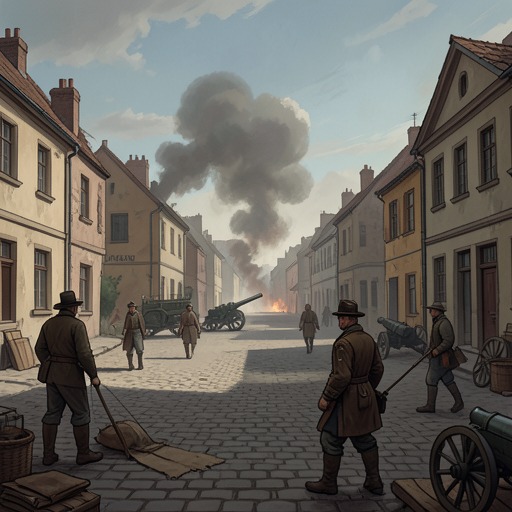
A shell struck the church, and the attack was followed almost immediately by the departure of Little Starhorodivka’s residents. Families first sent wives and children to relatives in Russia, Odessa, and Mykolayiv; fathers left afterward, some becoming separatists and others refugees. The elderly were taken away last, weeping and cursing. With the church damaged and the population thinning, the village’s ordinary social world gave way to boarded doors, plywood-covered windows, and an oppressive quiet.
When Sergeyich later walked along Lenin Street, the church was no longer there. The narration makes its absence tangible by recalling the view he would once have had—the dome above the street and the blue walls appearing as he drew nearer—before setting that remembered route against the present. He could walk in the middle of the road because his car was the only one in that half of the village, parked in his garage and waiting for better days. The missing church is thus part of a wider disappearance: familiar buildings, neighbors, traffic, and the sounds of daily life have all been taken away or silenced.
Candles, Faith, and Survival
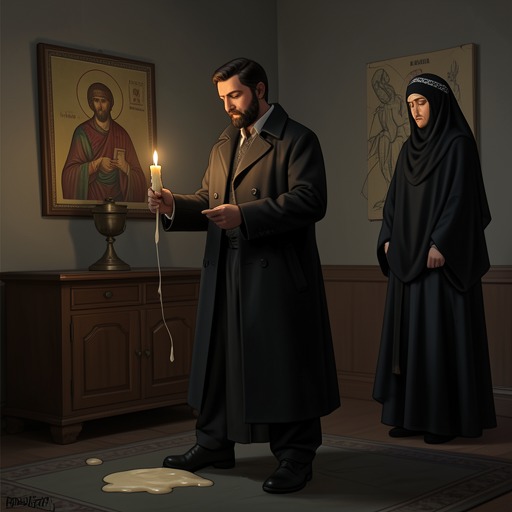
The shelling also opened the stone outbuilding beside the wooden church. The next morning, Sergeyich found two boxes of candles there and brought them home, one box at a time. For years he had donated beeswax so the priest could make candles; he understands the recovered supplies as a return for that giving, a gift from the Lord arriving when it was needed. After the power was cut off, the candles became his dependable light, making the church’s destruction the unlikely source of illumination in his house.
The candles have a material use beyond their religious association. Their waxed paper can help start a fire even in rain, and Sergeyich values it for precisely that practical reliability. He keeps the candles among the things that sustain his winter routine: coal for the stove, water heating on a burner, salted buckwheat for dinner, and old books read by candlelight. In his understanding, making light in dark times remains holy work, even after the church that supplied the candles has burned.
Memory, War, and the Empty Site
The church’s ruined site remains a point of reference even after the building itself disappears. Sergeyich measures the distance from his home to the church as less than a kilometre, and, on a later walk, the narration names the households along the way. The route makes the place legible through neighboring families as well as streets; the church is not an isolated monument but an anchor within a close-knit village whose houses and inhabitants are also being lost.
That familiar route acquires a more threatening meaning when Sergeyich notices tracks crossing the road between the Popovs’ and the Krupins’ houses. The trail leads to an abandoned home and then to a garden where roughly twenty bullet casings lie beside a thick bed of straw. Remembering a soldier’s warning that a sniper had been firing from the direction of the church, Sergeyich stands above the sniper’s lair and realizes that shooting from there may provoke an artillery response. The former landmark is now associated not only with communal and religious memory but with the direction of fire and the danger of retaliation. Its absence cannot erase its role in the geography of war: the destroyed church continues to orient both memory and fear.